What the carbon plate actually does
Super shoes cut the energy cost of running by about 4%. The surprise from the lab — most of it is the foam, not the plate.
- In 2018, all 18 high-level runners in a lab test used about 4% less energy in a prototype super shoe than in two established marathon racing shoes.
- When researchers cut the carbon plate of a super shoe into pieces, running economy got worse by only 0.55% on average — not a significant difference. The foam does most of the work.
- The effect differs a lot between people: in a 2026 study of 64 runners it ranged from 2.6% worse to 11% better.
Since 2017, road running has had a new kind of shoe. The industry calls it advanced footwear technology. Everyone else calls it a super shoe. Records from 5 km to the marathon have fallen in them, and the carbon plate inside became the symbol of the whole thing.
The research tells a less obvious story. Here is what a super shoe is, how much it actually helps, who it helps, and what the rules allow.
Three parts that work together
A super shoe is not one invention. It is three, built into one sole:
- A thick, soft and springy foam. The first super shoe used a very light foam based on PEBA. It squashes easily when you land and gives most of that energy back as it springs up again.
- A stiff, curved plate running through the foam, often made of carbon fibre.
- A rocker shape. The sole curves up at the toe, so the foot rolls forward instead of bending at the toes.
Inside a super shoe, layer by layer
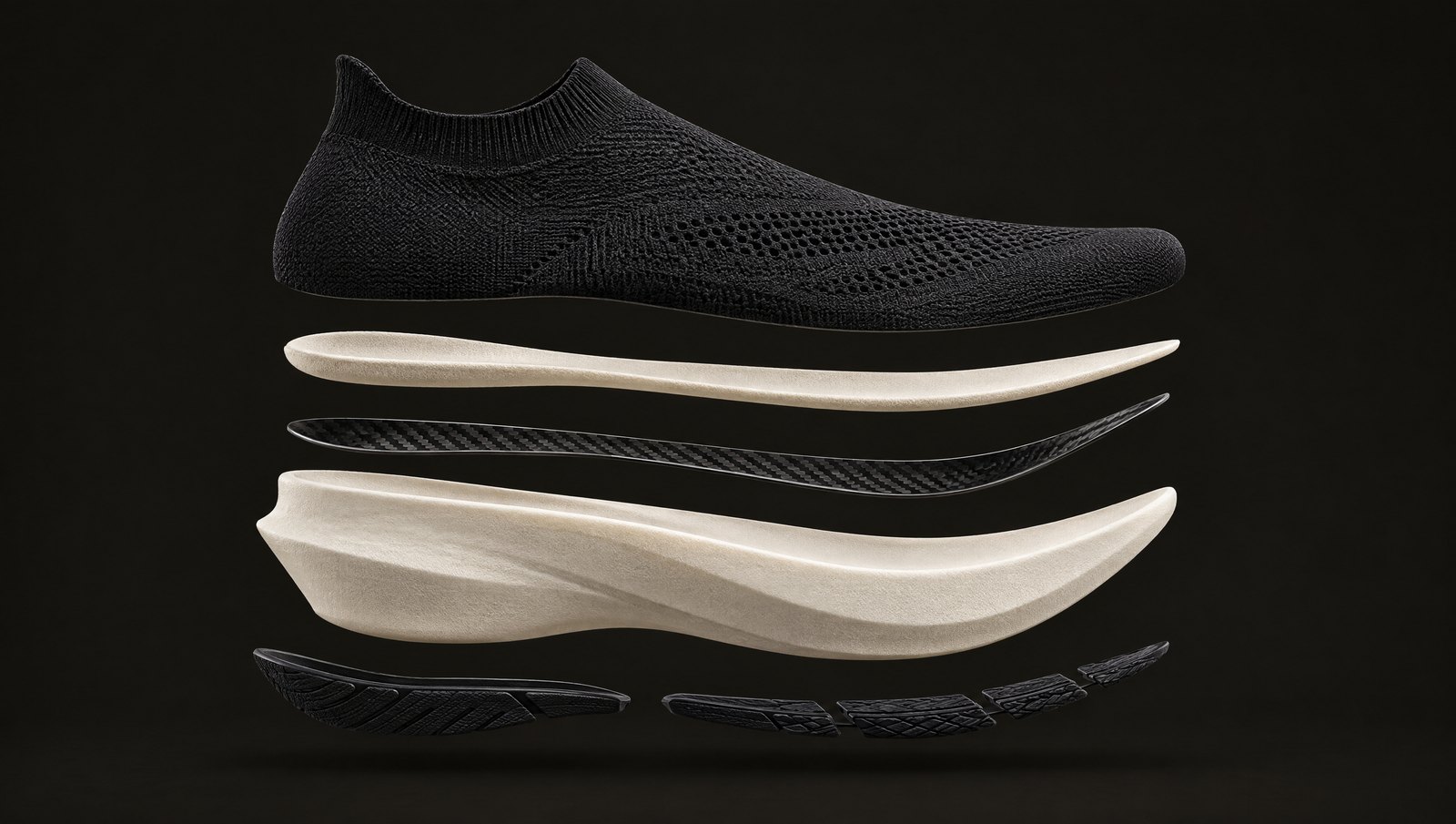 12345
12345
- Upper — thin knit, light, holds the foot
- Insole — thin layer the foot sits on
- Curved plate — stiff, often carbon fibre
- Main foam — thick and springy, the engine
- Outsole — thin rubber for grip
The 4% that started it
In 2018, Wouter Hoogkamer and colleagues at the University of Colorado tested a prototype that combined the new foam with a stiff embedded plate. Eighteen high-level runners ran six five-minute trials in three shoes — the prototype and two established marathon racing shoes from two big brands — at 14, 16 and 18 km/h. The shoes were matched for weight, and the researchers measured how much energy each runner used.
The prototype lowered the energy cost of running in all 18 runners. Averaged across the three speeds, it was 4.16% lower than in one racing shoe and 4.01% lower than in the other. That prototype became the first super shoe, introduced in 2017.
It is mostly the foam
If the plate is the magic part, taking it away should take most of the benefit with it. In 2022, Healey and Hoogkamer tested exactly that. They took that first super shoe and made six cuts across the carbon plate in the forefoot, so it could no longer stiffen the shoe. Fifteen runners then ran at 14 km/h in the intact shoe and in the cut one.
Running economy barely moved. In the cut shoe it was on average 0.55% worse, and the difference was not statistically significant. The only clear change was at the joint where the toes meet the foot: without the working plate, the toes bent more.
The research in three numbers
A 2026 systematic review of 14 experimental studies points the same way. Shoes that combine a carbon plate with a resilient foam improved running economy by 2.6 to 4.2%. Carbon-fibre insoles on their own — a plate without the foam — showed no significant benefit for performance or energy cost.
So the plate is not useless. The researchers suggest it matters mostly for how the toe joint moves. But the large saving comes from the foam, and from how foam, plate and shape work together.
Does it work if you are not fast?
The first studies used fast runners at race pace. Most people run slower. Two newer studies looked at that.
In 2023, Joubert, Dominy and Burns tested a current super shoe against a control shoe of the same weight at 10 and 12 km/h — roughly a 6:00 and a 5:00 minute-per-kilometre pace. At 12 km/h, runners used 1.4% less oxygen. At 10 km/h, the difference was 0.9% and not statistically significant. The benefit was still there, but smaller than at faster speeds.
In 2026, Hébert-Losier and colleagues tested 64 runners, half of them women, at an easier effort — 70% of their maximal aerobic capacity. In a super shoe they used on average 4.13% less oxygen than in a normal training shoe from the same brand.
The faster you run, the more you save
Energy saved in a super shoe compared with a normal shoe, by running speed. Hollow dot: not statistically significant.
The two newer studies do not fully agree, and they used different shoes and different comparison shoes. The fair summary: slower runners can benefit too, but how much depends on the shoe, the speed and the person.
The average hides the runner
The most useful number in the 2026 study is not the average. It is the spread. The same shoe saved one runner 11% and cost another 2.6%. Using 2.5% as the line for a clear benefit, 53 of the 64 runners were above it and 11 below.
Same shoe, 64 runners
One dot per runner. Filled: saved more than 2.5% of energy. Hollow: less than that — for some, the shoe made running harder.
The researchers looked for what separates the two groups. Runners with a stiffer calf muscle, relative to leg length, tended to benefit more. But everything they measured together explained only about a quarter of the differences. In practice, the only way to know is to try the shoe yourself.
From energy to minutes
Saving energy is not the same as running faster by the same amount. A 2025 review sums up the research: an improvement of 2 to 4% in running economy translates into roughly 1 to 2% in performance.
For a runner who finishes a marathon in 3 hours 30 minutes, 1 to 2% is about 2 to 4 minutes. That is our own arithmetic, not a measured result — but it shows why so many people are willing to pay for these shoes.
What 1–2% could mean over a marathon
Minutes saved if a shoe improves performance by 1 to 2%. Our own arithmetic from the finish time — an illustration, not a measured result.
The race between brands is not over. A 2026 study of a new prototype, designed with computer models built from runners’ biomechanical data, measured a further 3.2 to 3.6% improvement over three current super shoes — including the brand’s own previous model — in 15 trained runners.
What the rules allow
World Athletics limits these shoes in ranked competition. The current Athletic Shoe Regulations were approved on 2 December 2025 and apply from 1 January 2026. Among the main rules:
- Road races: the sole can be at most 40 mm thick.
- Track events: at most 20 mm.
- One rigid structure only: a road shoe may not contain more than one plate or other rigid part.
- Available to buy: a shoe must be on sale to the public, or be an approved development shoe.
These rules decide what elite athletes can wear in ranked competitions.
What we take from it
What looks like the feature is not always what does the work. The plate is visible, easy to explain and easy to sell. The foam is quieter and does most of the job. It is a useful rule for anything you wear to train in: judge it by what it does for you, not by what it is made to look like.
Read the research
- Hoogkamer W, Kipp S, Frank JH, Farina EM, Luo G, Kram R. A comparison of the energetic cost of running in marathon racing shoes. Sports Medicine. 2018. doi:10.1007/s40279-017-0811-2
- Healey LA, Hoogkamer W. Longitudinal bending stiffness does not affect running economy in Nike Vaporfly shoes. Journal of Sport and Health Science. 2022. doi:10.1016/j.jshs.2021.07.002
- Joubert DP, Dominy TA, Burns GT. Effects of highly cushioned and resilient racing shoes on running economy at slower running speeds. International Journal of Sports Physiology and Performance. 2023. doi:10.1123/ijspp.2022-0227
- Hébert-Losier K, Cumming C, Bidois B, Nguyen AP, Giandolini M. Exploring factors to explain interindividual responses to running economy in advanced footwear technology shoes. Sports Medicine – Open. 2026. doi:10.1186/s40798-026-01091-0
- Alexe CI, Choudhary PK, Choudhary S, Saha S, Panaet EA, Alexe DI. Emerging sports footwear technologies and their effects on running economy, biomechanics, and performance: a systematic review. BMC Sports Science, Medicine and Rehabilitation. 2026. doi:10.1186/s13102-026-01721-w
- Bruvere DD, Bernans E. Mechanisms, economy, and performance of advanced footwear technology in endurance running — a review. Muscles. 2025. doi:10.3390/muscles5010002
- Kuzmeski J, Bertschy M, Healey L, Barrons Z, Hoogkamer W. Data driven shoe design improves running economy beyond state-of-the-art advanced footwear technology running shoes. Journal of Sport and Health Science. 2026. doi:10.1016/j.jshs.2026.101133
- World Athletics. Athletic Shoe Regulations (Book C, C2.1A). Approved 2 December 2025, effective 1 January 2026. worldathletics.org
Checked against the original papers and the World Athletics regulations, 30 September 2026. Educational content — not medical advice.